





Leveraging MiTAC’s Capri OCP Compute and Lake Erie Storage Platforms with Flexible ORv3 Rack Design
Executive Summary
As Cloud Service Providers (CSPs) continue to scale AI and big data workloads, Open Compute Project (OCP)–based data center architectures have become a strategic choice for achieving higher energy efficiency, openness, and rack-level scalability. This case study highlights the collaboration between MiTAC Computing, ITOCHU Techno-Solutions America, Inc(hereinafter “CTCA”), a global system integrator, and Actapio, a subsidiary of LY Corporation and a leading operator of OCP-based environments, in deploying a large-scale, ORv3–ready data center infrastructure in the United States.
The project demonstrates how MiTAC’s OCP-native compute and storage platforms—Capri series OCP servers and Lake Erie OCP JBOD storage servers—combined with flexible rack-level design and close ecosystem collaboration, successfully addressed complex CSP-grade challenges, including power efficiency, configurability, and rapid scalability.
Customer Background
Actapio operates large-scale data centers in the United States, supporting big data analytics and AI platforms. As an early adopter of Open Compute Project standards, Actapio has continued to expand its infrastructure through open architectures since 2015, while steadily strengthening its AI capabilities.
To support the next phase of growth, Actapio, together with CTCA, initiated a major infrastructure expansion focused on OCP ORv3 adoption, big data workloads, and long-term scalability.
Solution Provider Background: MiTAC Computing
MiTAC Computing is an active contributor to the Open Compute Project and has been an OCP Gold Member since 2017, with a long-term commitment to designing, developing, and manufacturing OCP native platforms for large-scale and CSP data centers. With experience across multiple OCP generations, MiTAC delivers flexible, highly customizable platforms and rack-scale solutions, while maintaining production-ready standardization.
Challenges Faced by CSP-Scale OCP Deployments
From the CSP perspective, the project introduced several structural and operational challenges:
- Rack-Level Flexibility at Scale
Supporting diverse workload profiles required a high degree of flexibility at the rack level without compromising OCP standardization or operational stability.
- Architecture Transition Complexity
Scaling AI and big data workloads while transitioning to Open Rack Base Frame V3 architecture increased complexity across power, rack design, and system integration.
- Limited Availability of OCP-Compliant Storage Solutions
The market offered few ORv3-compliant JBOD storage options capable of meeting capacity, performance, and integration requirements.
- Large-scale Deployment Predictability
Managing large-scale expansion while maintaining predictable deployment timelines, consistent quality, and long-term scalability was a critical challenge.
MiTAC & CTCA Joint Solution Strategy
MiTAC Computing worked closely with Actapio and CTCA from concept design through commercialization, delivering a fully validated OCP solution.
- OCP-Compliant Compute Platform: Capri Series
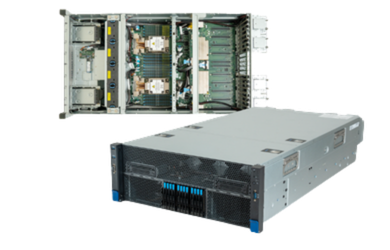
MiTAC Capri Series OCP Servers were selected as the primary compute nodes. Designed natively for OCP environments, Capri supports:
- High compute density
- ORv3 rack integration
- Compatibility with data-intensive and high-throughput workloads
- OCP-Compliant Storage Platform: Lake Erie JBOD
To address the lack of suitable OCP storage solutions, MiTAC co-developed and commercialized an ORv3-compliant JBOD:
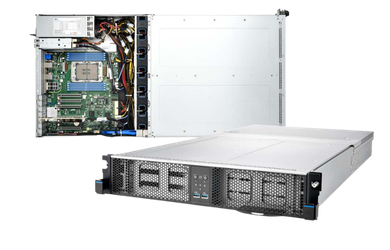
Lake Erie Storage Server
- 2OU, 3-node architecture
- Supports up to 36 x SAS4 HDDs (3.5” / 2.5”)
- Optimized for big data and HPC storage workloads
- Fully compliant with ORv3 mechanical and power standards
This solution enabled seamless integration with OCP racks while delivering the capacity and reliability required by CSP-scale environments.
Product reference: Lake Erie OCP JBOD Storage Server (LE2S01)
- Flexible ORv3 Rack Configuration Design
Rather than a single fixed rack blueprint, MiTAC and CTCA delivered:
Highly flexible, purpose-oriented OCP rack configurations supporting diverse workloads, depending on:
- Compute-to-storage ratio
- AI vs. big data workloads
- Power and cooling conditions
This design approach allowed Actapio to scale incrementally while maintaining standardization and operational consistency.
- 48V Power Architecture for Efficiency
The adoption of ORv3-compliant 48V power systems significantly reduces power conversion losses compared to traditional 12V architectures, while improving rack-level energy efficiency and thermal performance. This power architecture directly aligns with CSP objectives to lower total cost of ownership and support long-term sustainability initiatives.
Deployment Results & Business Impact
The deployment delivered tangible, CSP-relevant outcomes that validated both the architectural approach and MiTAC’s platform flexibility. Approximately 2,500 OCP-compliant servers were deployed across more than 100 racks in a U.S. data center environment, supporting production-scale AI and big data workloads.
The project achieved high operational stability and predictable deployment outcomes despite architectural complexity. Standardized OCP designs and pre-validated configurations enabled faster deployment and expansion cycles, while maintaining consistency across large-scale deployments.
Beyond scale, the project established a repeatable OCP deployment model that CSPs can reuse for future data center expansions.
Value for CSPs
This success story highlights how MiTAC’s flexibility and strong customization capability translate into real value for CSPs operating at scale:
-
Platform-Level Flexibility
MiTAC’s OCP-native portfolio allows CSPs to flexibly mix compute and storage resources within ORv3 racks, adapting to changing workload requirements without redesigning the entire infrastructure. -
Deep Customization Without Fragmentation
Supports a wide range of rack configurations while maintaining standardized, production-ready designs that reduce operational risk. -
Co-Development as a Service Model
MiTAC works with CSPs and system integrators from concept design to commercialization, enabling rapid delivery of platforms that do not yet exist in the open market, such as ORv3-compliant JBOD storage. -
Lower Long-Term TCO
Energy-efficient 48V power architecture and standardized rack designs reduce integration effort and operational costs over time. -
Future-Ready OCP Architecture
The solution is designed to support next-generation AI platforms, higher power density, and upcoming cooling technologies, protecting CSP investments over multiple deployment cycles.
Conclusion
This MiTAC Computing × CTCA × Actapio collaboration demonstrates how CSPs can successfully deploy large-scale, ORv3-ready OCP data center infrastructure without sacrificing flexibility, efficiency, or operational stability.
By combining Capri series OCP compute platforms, Lake Erie OCP storage servers, and a highly flexible rack-level design strategy, MiTAC delivered a solution capable of supporting diverse workloads through purpose-oriented rack configurations, all within a standardized OCP framework.
More importantly, the project highlights MiTAC’s role beyond a traditional hardware supplier. Through deep customization, co-development, and end-to-end OCP expertise, MiTAC acts as a long-term data center infrastructure partner for CSPs building scalable, energy-efficient, and future-ready data centers.
MiTAC Computing – Powering Future Compute